
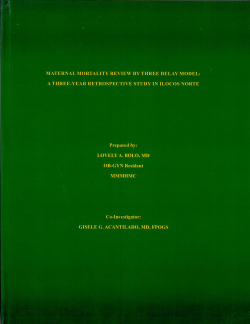
Maternal Mortality Review by Three Delay Model: A Three-Year Retrospective Study in Ilocos Norte
Type
Other
Authors
Category
Clinical Research--Retrospective analysis
[ Browse Items ]
Publication Year
2025
Publisher
Pages
52 p
Subject
maternal death--causes--Ilocos Region; maternal death--evaluation framework
Abstract
Safeguarding maternal health is dependent on the creation of a healthy baby, a healthy mother and a healthy world. Improving maternal health minimizes complications pregnancy and childbirth. Maternal health continues to be a global concern and in Philippines, it recorded an average Maternal Mortality Rate (MMR)of 125 from 2014
2017. In Ilocos Region, significant reduction in MMR was achieved from 2016 to 2019, however, there was a rise of MMR, which peaked in 2021 where it recorded an MMR of 77.17.2
The “three delay model” proposed by Thaddeus and Maine (1990) is a framework used to evaluate the reasons for maternal death in terms of identifying hindrances in maternal care that can be studied to improve maternal health. This study to identify causes of maternal death in Ilocos Norte using the three delay model.
This study included all maternal deaths that occurred in Ilocos Norte from 2020-2022 that met the definition of the World Health Organization for maternal death. A of 36 maternal deaths were recorded from various healthcare facilities in Ilocos Norte from 2020 to 2022 . 24 patients were residents of Ilocos Norte while 12 were from nearby provinces. The types of delays were identified and the most common cause of death were recorded. Since this was during the COVID-19 pandemic, 10 deaths are due COVID infection. Severe preeclampsia (n=8, 22.22%) is the most common cause of maternal death. Type I delay (delay in seeking care) is the most common comprising 50% (n=18) of the cases, followed by Type II delay (delay in reaching a first-level health facility) which is 44.44% (n-16), and the last is Type III delay (delay in receiving adequate care in the facility). COVID-19 pandemic resulted in a lot of restrictions in movements especially for pregnant women, due to high risk, and contributed to the delays observed in this study.
In conclusion, this study reinforces that delays in recognizing complications, reaching healthcare facilities, and receiving adequate care significantly impact maternal outcomes. The findings highlight the urgent need for increased awareness, improved transportation infrastructure, and better financial support to ensure timely access to maternal healthcare services. Strengthening antenatal care and ensuring prompt medical attention are crucial steps in safeguarding maternal health and preventing deaths. This study can be further improved by combining quantitative and qualitative approaches to gain a deeper understanding of maternal health challenges.
2017. In Ilocos Region, significant reduction in MMR was achieved from 2016 to 2019, however, there was a rise of MMR, which peaked in 2021 where it recorded an MMR of 77.17.2
The “three delay model” proposed by Thaddeus and Maine (1990) is a framework used to evaluate the reasons for maternal death in terms of identifying hindrances in maternal care that can be studied to improve maternal health. This study to identify causes of maternal death in Ilocos Norte using the three delay model.
This study included all maternal deaths that occurred in Ilocos Norte from 2020-2022 that met the definition of the World Health Organization for maternal death. A of 36 maternal deaths were recorded from various healthcare facilities in Ilocos Norte from 2020 to 2022 . 24 patients were residents of Ilocos Norte while 12 were from nearby provinces. The types of delays were identified and the most common cause of death were recorded. Since this was during the COVID-19 pandemic, 10 deaths are due COVID infection. Severe preeclampsia (n=8, 22.22%) is the most common cause of maternal death. Type I delay (delay in seeking care) is the most common comprising 50% (n=18) of the cases, followed by Type II delay (delay in reaching a first-level health facility) which is 44.44% (n-16), and the last is Type III delay (delay in receiving adequate care in the facility). COVID-19 pandemic resulted in a lot of restrictions in movements especially for pregnant women, due to high risk, and contributed to the delays observed in this study.
In conclusion, this study reinforces that delays in recognizing complications, reaching healthcare facilities, and receiving adequate care significantly impact maternal outcomes. The findings highlight the urgent need for increased awareness, improved transportation infrastructure, and better financial support to ensure timely access to maternal healthcare services. Strengthening antenatal care and ensuring prompt medical attention are crucial steps in safeguarding maternal health and preventing deaths. This study can be further improved by combining quantitative and qualitative approaches to gain a deeper understanding of maternal health challenges.
Number of Copies
1